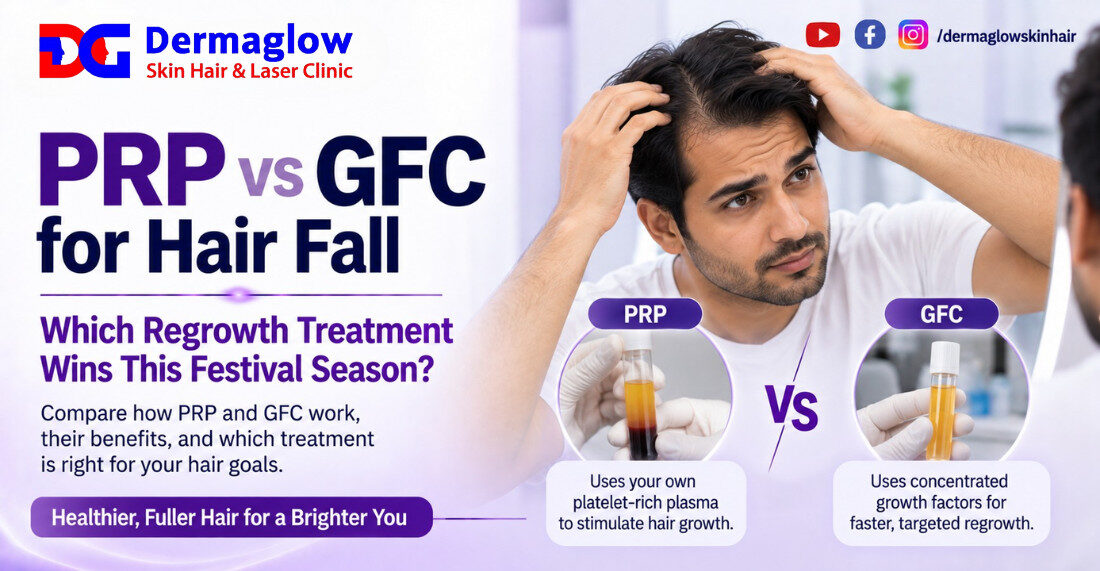
Hair fall complaints spike every year right before festival season partly genuine seasonal shedding left over from the monsoon, and partly the sudden pressure of wanting thick, photo-ready hair for Vinayaka Chavithi and Dasara functions. Two treatments dominate the conversation at our clinic right now: PRP and GFC. Both are blood-derived regrowth therapies, both are genuinely backed by growing clinical evidence, and both get recommended for very similar-sounding concerns which is exactly why patients keep asking us which one actually wins.
What PRP Actually Is
Platelet-Rich Plasma (PRP) therapy involves drawing a small sample of your own blood, spinning it in a centrifuge to concentrate the platelets which are rich in growth factors and injecting this concentrated plasma into the scalp at the level of the hair follicles. Those growth factors stimulate blood supply to the follicle and can help extend the hair’s active growth phase. Because it uses your own blood, the risk of allergic reaction is minimal, and it’s one of the more extensively studied regenerative treatments for pattern hair loss and early-stage thinning.
What GFC Actually Is
Growth Factor Concentrate (GFC) therapy also starts with your own blood but processes it differently the sample is treated to isolate and concentrate a broader range of growth factors, without red blood cells or as many other blood components, into a purer growth-factor-rich solution. Because the final concentrate is more refined, many patients report a smoother injection experience with less post-procedure discomfort compared to PRP. GFC has been gaining ground as an alternative, particularly for patients with sensitive scalps or lower pain tolerance.
Head-to-Head: How They Actually Compare
- Mechanism: Both stimulate follicles using growth factors from your own blood GFC’s processing yields a more concentrated, refined solution
- Comfort: GFC is generally reported as more comfortable during injection; PRP is well-tolerated too but can cause slightly more post-session tenderness
- Best suited for: PRP is well-established for general pattern hair thinning; GFC is often preferred for sensitive scalps or patients wanting a gentler protocol
- Sessions needed: Both typically require a series of sessions spaced 3–4 weeks apart, with visible improvement usually assessed after 3–4 sittings
- Combination potential: Many patients see the best results pairing either treatment with topical therapy and addressing underlying causes like scalp infection or nutritional deficiency
Which One Should You Choose?
Neither treatment is universally “better” — the right choice depends on the pattern and stage of your hair loss, your scalp sensitivity, and what’s actually driving the shedding in the first place. Hair fall triggered by monsoon scalp infections, for instance, needs that underlying issue treated first; layering PRP or GFC on top of an active fungal or dandruff problem won’t give either treatment a fair chance to work. If that sounds familiar, our guide on Monsoon Hair Care Routine is a useful starting point, and our Hair Treatments page covers both PRP and GFC alongside our dandruff and scalp detox protocols in more detail. A scalp analysis at consultation — checking follicle density, scalp health, and the pattern of shedding — is what actually decides which treatment (or combination) makes sense, rather than picking one off a menu.
Dr. S. Sumanth Yadav and Dr. N. A. Tejaswitha Gudivada run both PRP and GFC protocols at our Kothapet and Bandlaguda clinics, and starting a series now gives you the best shot at visible improvement by the time Dasara photos roll around. Book a scalp consultation here to find out which one is right for you.